
How to Get More Direct Bookings (and Rely Less on OTAs)
OTAs like Viator, GetYourGuide, and Klook can put your tours in front of thousands of travelers. But every commission-based reservation reduces the revenue you keep, and heavy OTA dependence ties your business to someone else’s marketplace, rankings, and policies.
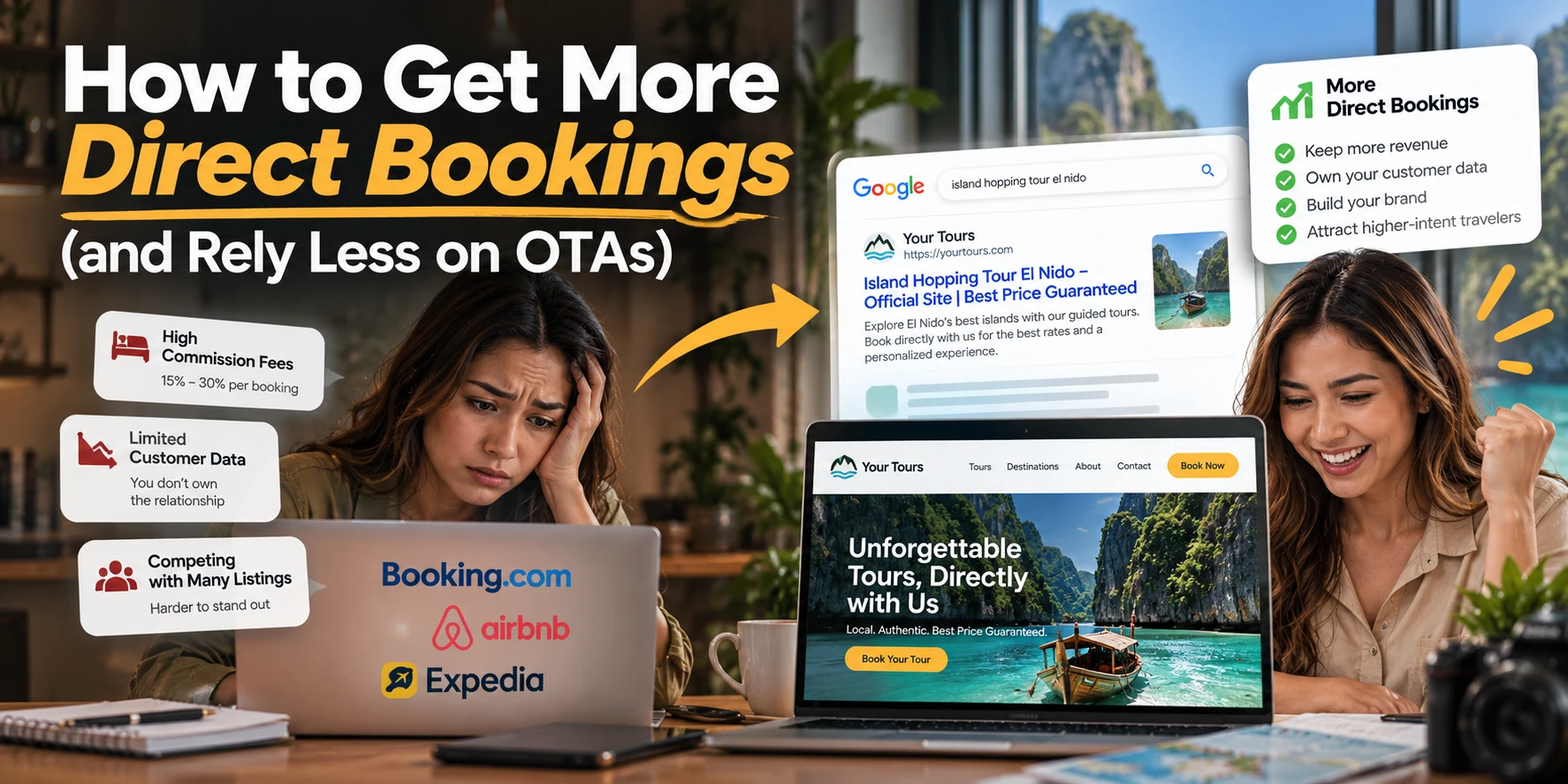
- Don’t abandon OTAs. Build your own booking channel alongside them so you aren’t relying entirely on third-party marketplaces.
- OTA commissions vary by platform and agreement, and some operators now pay 30% or more. A direct sale can keep noticeably more revenue, but only if your own acquisition costs stay sustainable.
- The seven levers: tourism SEO, Google Business Profile, Google Things to do, an easier booking experience, repeat guests and referrals, branded search, and tracking direct booking share and revenue.
- Start with the foundation: make sure your website converts and your bookings are measured before chasing more traffic.
- Judge progress by direct revenue and profitability, not just rankings, traffic, or booking share.
To get more direct tour bookings, improve your website’s search visibility, attract travelers with booking intent, simplify online reservations, and build customer relationships that generate repeat bookings and referrals.
That doesn’t mean walking away from OTAs. It means developing your own booking channel next to them.
In this guide, I’ll explain seven practical strategies to increase direct bookings, how to calculate the true cost of OTA dependency, and how to build a 90-day plan that connects tourism SEO with measurable business results.
What Are Direct Bookings for Tour Operators?
A direct booking happens when a customer reserves a tour through a sales channel your business manages, rather than completing the transaction through an online travel agency. Direct channels can include:
- Your official tour website
- An online booking engine connected to your website
- Phone reservations and direct email inquiries
- Walk-in reservations
- Approved direct messaging channels
For example, a traveler searches Google for “private sunset cruise in Miami,” visits your website, picks a date, and completes the reservation. That’s a direct website booking. If the same traveler finds your tour on Viator and pays through Viator, it’s an OTA booking, even though your business runs the experience.
The difference matters because the two involve different acquisition costs, fees, customer relationships, and operational responsibilities.
Direct bookings vs. OTA bookings
| Factor | Direct bookings | OTA bookings |
|---|---|---|
| Booking channel | Your website or direct sales | Third-party marketplace |
| OTA commission | None on a genuinely direct sale | Depends on supplier agreement |
| Marketing costs | SEO, advertising, referrals, and other acquisition costs | Often partly included in OTA distribution |
| Customer relationship | Managed by your business | Subject to OTA policies and data access |
| Pricing flexibility | Subject to your own costs and agreements | Subject to marketplace agreements |
| Repeat booking opportunities | Can be built through permitted direct marketing | May be limited by platform terms |
Neither model is automatically better. An OTA booking that fills an otherwise empty departure is still valuable revenue. The goal is a more balanced distribution strategy with several reliable ways to attract travelers.
Why Relying Too Much on OTAs Can Hurt Your Profitability
OTAs provide distribution, reach, booking infrastructure, and marketplace visibility. In exchange, they collect a commission on eligible reservations, and the rate varies by platform, destination, product, and supplier agreement.
In 2025, Arival reported that some GetYourGuide suppliers were facing commission increases, including rates of 30% or more in particular cases. That doesn’t mean every operator pays 30%, so check your current supplier agreement for your actual rate.
How much revenue do OTA commissions consume?
Take a hypothetical guided tour priced at $150 with a 25% OTA commission:
Now compare a direct booking, assuming $12 in attributable acquisition costs and $5 in payment processing:
| Item | OTA booking | Direct booking |
|---|---|---|
| Tour selling price | $150 | $150 |
| OTA commission | $37.50 | $0 |
| Direct acquisition cost | $0 separately allocated | $12 |
| Payment processing | Assumed in OTA arrangement | $5 |
| Revenue remaining after listed costs | $112.50 | $133 |
That isn’t necessarily $20.50 more profit. Website maintenance, booking software, marketing labor, refunds, and other expenses also count. Direct bookings improve financial performance only when the total cost of acquiring and serving those customers is sustainable.
The hidden risks of OTA dependency
Commission is only one consideration. A tour business that leans heavily on OTAs can also face:
- Marketplace ranking changesVisibility can drop when platforms adjust their search and recommendation systems.
- Limited customer communicationAccess to guest contact details and promotional messaging may be restricted.
- Competitive pressureSimilar experiences appear beside your listing, sometimes with aggressive pricing.
- Platform policy changesCommission structures and distribution programs can change.
- Revenue concentrationRelying on one booking source adds business risk.
A diversified booking strategy reduces dependence on any single platform and gives you more control over how travelers find you.
7 Ways to Increase Direct Bookings for Your Tour Business
More direct bookings come from combining search visibility, website conversion, customer experience, and measurement. These seven strategies cover the journey from discovery to completed reservation.
1Improve Tourism SEO to Attract Travelers Ready to Book
Not every search carries the same booking intent. “Things to do in Paris” is research. “Private luxury walking tour in Paris” is someone much closer to booking.
Create dedicated pages for individual tour experiences
Don’t rely on one general tours page. Give each tour with a distinct offering and search intent its own page, such as private Paris walking tours, luxury day trips from Paris, private Loire Valley château tours, or custom countryside excursions. Each page should include:
- Tour name, destination, duration, and itinerary
- Starting price and inclusions
- Meeting point or pickup arrangements
- Group size and suitability
- Real photographs and relevant reviews
- Availability and booking options
Build a semantic relationship between destinations and experiences
Organize content around how destinations, activities, and traveler needs actually connect. A luxury France tour site might use luxury private tours in France as the main topic; Paris, Loire Valley, Provence, and Normandy as destination topics; private city tours, château visits, wine experiences, and countryside excursions as experience topics; and itineraries, transport, pricing, accessibility, and booking as supporting information. That creates meaningful links between pages instead of treating every keyword in isolation.
Publish destination guides that support commercial pages
Guides like “Best Time to Visit the Loire Valley,” “Things to Do in Paris for First-Time Visitors,” or “Private vs. Group Tours in France” reach travelers earlier in their research. They should answer real questions and link naturally to bookable experiences, for example a Loire Valley guide linking to a private château tour when it covers getting around.
Why professional tourism SEO matters
Ranking for destination and activity searches takes more than keywords in titles. It means understanding intent, organizing topics, strengthening internal links, and fixing technical issues. My SEO strategy, technical optimization, and local SEO services focus on connecting site structure, content relevance, and business goals.
2Optimize Your Google Business Profile for Local Tour Searches
Travelers already at their destination search on their phones: “walking tours near me,” “boat tours in Miami,” “kayak rental near me.” Those searches often show Google Maps and local results.
How to improve your profile
First confirm your business qualifies under Google’s guidelines. Then focus on:
- Your real business name and the most accurate primary category
- Correct contact details and operating hours
- Authentic business and tour photos
- Descriptions of the services you actually provide
- Genuine reviews, requested without prohibited incentives, and responses to feedback
A temporary meeting point doesn’t automatically qualify as a separate profile location. Operators without a qualifying storefront should review Google’s service-area business rules.
Connect your listing to your website
Link the profile to your official site and help visitors reach the right tour information without detours.
3Connect Your Booking System to Google Things to do
Google Things to do can show eligible tours and activities with booking links to participating providers, reaching travelers while they compare options.
Check whether your reservation system supports Things to do connectivity. Some booking platforms and channel managers integrate through approved connectivity partners. Review:
- Whether your tours qualify and which products are supported
- Whether direct booking links are available
- How pricing and availability sync
- Any integration or provider fees
- Whether your products qualify for free or paid surfaces
Not every operator or activity is eligible, and connecting doesn’t guarantee visibility. The point is to open another discovery channel that leads to your own booking experience. See Google’s Things to do documentation for current requirements.
4Make Your Direct Booking Experience Easier
Travelers are used to OTA checkouts with live dates, clear prices, and reviews. If your site makes booking harder, some will go back to the marketplace.
Make availability visible
Show available dates and departure times without waiting for a manual reply whenever your model allows. If a date is unavailable, offer alternatives.
Explain prices clearly
Show starting prices, fees, group rates, inclusions, and cancellation terms. Avoid surprise mandatory charges at payment.
Optimize mobile booking
Test the whole flow on a phone: date selection, participant details, payment, and confirmation.
Build trust with authentic information
Use genuine reviews, real tour photos, guide information, and clear policies so travelers know what they’re paying for.
Offer genuine direct-booking advantages
Depending on your model and OTA agreements, you might offer extra flexibility, relevant extras, or easier access to customized experiences. Check your supplier contracts before advertising price differences or special offers.
5Turn Satisfied Guests Into Repeat Customers and Referrals
An OTA may introduce a traveler, but the tour itself is your chance to be remembered, recommended, and searched for by name next time.
- Make your brand memorable: keep your business name visible and consistent across your website, guide communications, and guest-facing materials.
- Encourage genuine reviews: ask for honest feedback and follow each platform’s rules, with no prohibited incentives.
- Make referrals convenient: help guests find your official website and public social profiles, and where permitted, your other experiences.
- Build appropriate follow-up: for guests who’ve given the necessary permissions, send thank-you messages, feedback requests, or relevant future experiences.
6Improve Branded Search Visibility and Referral Traffic
Travelers who hear about you from friends, hotels, social media, or an OTA listing often Google your business name later. Your official site should win that search.
Make your official website easy to identify
Your homepage should clearly show your business name, destinations, tours, contact information, why travelers should choose you, and how to book directly. Keep branding consistent across your public profiles.
Develop relevant local partnerships
Hotels, local tourism organizations, travel advisers, destination publishers, and complementary tour businesses can introduce travelers without an OTA in the middle. These partnerships may carry fees or commissions too, so include them in your channel profitability analysis.
Build useful pathways to your booking pages
When promoting a specific activity, link to its landing page rather than the homepage. Someone interested in a private food tour shouldn’t have to search your whole site for it.
7Track Direct Booking Share, Revenue, and Acquisition Costs
You can’t reduce OTA dependency without knowing where your bookings come from today.
Categorize reservations by actual sales channel (direct website, phone or email, walk-in, Viator, GetYourGuide, Klook, other resellers, referral partners) and track completed bookings separately from canceled or refunded ones.
If you complete 200 reservations in a month and 80 came through direct channels, your direct booking share is 40%. That doesn’t mean direct bookings bring in 40% of revenue: an $800 private tour and a $50 shared ticket contribute very differently.
Monitor the complete channel picture
| Metric | What it tells you |
|---|---|
| Direct booking share | Percentage of reservations acquired directly |
| OTA booking share | Dependence on external platforms |
| Direct booking revenue | Sales generated through direct channels |
| OTA commission expense | Cost of third-party distribution |
| Direct acquisition cost | Marketing spend tied to direct customers |
| Booking conversion rate | Share of relevant visits that produce reservations |
| Repeat booking rate | Customer retention performance |
| Contribution per booking | Value after defined variable costs |
Connect your booking system to GA4
Where your reservation platform supports it, configure GA4 ecommerce events:
view_item: visitor views a tourselect_item: visitor selects a tour or optionbegin_checkout: visitor starts checkoutadd_payment_info: payment information is submittedpurchase: booking is confirmed
For third-party booking engines, check whether cross-domain measurement and purchase-event integrations are available. Treat your reservation platform as the source of truth for confirmed bookings and reconcile it with analytics.
Tourism SEO in Practice: France Luxury Tour Case Study
Direct booking opportunities start with making the right experiences discoverable. My France Luxury Tour case study covers SEO strategy and website architecture for a luxury tourism business.
Why website architecture matters
A tourism site may offer many destinations, experiences, itineraries, and travel arrangements. If they aren’t organized clearly, visitors and search engines struggle to see how pages relate. A luxury tour site needs to connect luxury private tours in France, individual destinations like Paris or Provence, specific experiences and itineraries, supporting destination information, and reservation or inquiry options.
Connecting semantic SEO with commercial intent
Instead of isolated pages for every keyword variation, a structured approach organizes content around real relationships between destinations, services, and traveler needs. A page about luxury tours in France connects to destination and experience pages, and supporting articles answer questions about transport, itineraries, timing, and what to expect.
What tour operators can learn
Your site structure should support how travelers research and choose experiences: relevant destination pages, detailed tour information, useful internal links, and clear booking paths.
A 90-Day Plan to Increase Direct Tour Bookings
First make sure your website converts interested travelers and measures confirmed reservations. Then expand search visibility and retention.
Audit and fix the foundation
Goal: understand your current booking channels and remove the biggest conversion barriers.
- Calculate current direct and OTA booking share.
- Review commission expense and direct acquisition costs.
- Audit tour pages and the reservation process.
- Verify GA4 and booking engine tracking.
- Find mobile usability and checkout problems.
- Review Google Business Profile eligibility and optimization.
- Check Google Things to do support in your booking system.
- Booking channel baseline
- SEO and conversion audit
- Priority improvement list
- Tracking validation
- Local SEO opportunity assessment
Improve search visibility
Goal: make commercially important tours easier to discover.
- Optimize your highest-priority tour pages.
- Improve titles, headings, descriptions, and internal links.
- Resolve important technical SEO and indexing issues.
- Improve tour page content and booking calls to action.
- Publish one or two useful destination guides.
- Strengthen Google Business Profile information and reviews.
- Complete eligible Things to do integration steps.
- Improved priority landing pages
- Stronger internal linking
- Relevant destination content
- Local search improvements
- Updated booking page experience
Grow, measure, and refine
Goal: evaluate performance and expand what’s working.
- Compare direct bookings and revenue with the baseline.
- Review organic performance for priority tour pages.
- Investigate booking funnel abandonment.
- Improve branded search and referral opportunities.
- Introduce post-trip communication for eligible guests.
- Identify more commercial pages and destination topics.
- Build the next 90-day roadmap.
- Direct booking performance report
- Conversion recommendations
- Repeat and referral strategy
- Next-quarter SEO priorities
A 90-day plan builds the foundation for sustainable growth, but meaningful organic search gains can take several months. Focus on quality and commercial relevance over page count.
Which Direct Booking Strategy Should You Prioritize?
| Your situation | Priority |
|---|---|
| High website traffic but few bookings | Booking funnel and conversion optimization |
| Low organic search visibility | Tourism SEO and tour page optimization |
| Poor Google Maps visibility | Google Business Profile and local SEO |
| High OTA dependency | Distribution and channel profitability analysis |
| Many happy guests, few repeat customers | Retention and referral strategy |
| Unclear marketing ROI | GA4 and booking revenue tracking |
More SEO content isn’t the first priority if your booking system keeps failing on mobile. And a booking page redesign won’t do much if the site gets almost no relevant traffic. Find your biggest practical opportunity and start there.
How to Know Whether Your Direct Booking Strategy Is Working
Look beyond rankings and traffic for evidence that visitors find the right tours and complete reservations:
- Growth in relevant organic traffic to tour pages
- A higher direct booking conversion rate
- More completed website reservations
- Higher direct booking revenue
- Lower OTA dependence where financially beneficial
- Better contribution per booking
- More repeat and referral reservations
Account for seasonality, pricing changes, capacity, cancellations, and destination trends when reading results.
Need Help Increasing Direct Bookings for Your Tour Business?
More direct reservations isn’t just about more visitors. Your business needs to attract travelers with the right intent, present experiences clearly, offer a reliable reservation process, and measure which channels produce real bookings.
Through my SEO strategy, technical optimization, and local SEO services, I help businesses improve search visibility, organize their sites around real search demand, and turn traffic into business outcomes. You can also explore my France Luxury Tour case study.
Want more travelers booking directly, and fewer OTA commissions?
Book a free consultation to discuss your tourism website, current booking channels, and the opportunities to grow your direct bookings.
Frequently Asked Questions
How can tour operators get more direct bookings?
Tour operators can increase direct bookings through tourism SEO, Google Business Profile optimization, eligible Google Things to do integrations, better booking experiences, branded search visibility, and repeat customer strategies. The best starting point depends on whether the main problem is visibility, conversion, or customer retention.
What is the difference between direct bookings and OTA bookings?
Direct bookings happen through a tour operator’s own sales channels, such as its website or reservation team. OTA bookings happen through external marketplaces such as Viator, GetYourGuide, or Klook and are generally subject to the applicable reseller agreement.
What commission do Viator and GetYourGuide charge?
Commission rates vary by platform, product, destination, and supplier agreement. Industry reporting has documented rates around 20–30% and higher in some cases, but these aren’t universal. Review your current supplier agreement for the rate that applies to your business.
Can I offer lower tour prices on my own website?
That depends on your OTA agreements and applicable rules. Review your contractual obligations before advertising lower direct prices or exclusive offers. Where permitted, additional direct-booking benefits may be an alternative.
Is Google Things to do free for tour operators?
Google Things to do includes different discovery and advertising opportunities. Eligibility, integration requirements, and costs vary by product and provider. Participation doesn’t guarantee a particular placement or reservation volume.
How long does tourism SEO take to increase direct bookings?
It depends on competition, existing website authority, technical condition, search demand, and conversion performance. Some website improvements affect usability quickly, while organic visibility can take several months. No specific increase or timeline is guaranteed.
What percentage of tour bookings should be direct?
There’s no universal target. A useful target reflects your channel mix, margins, marketing costs, seasonality, and capacity. Monitor direct booking revenue and profitability alongside booking share.
Can I contact guests who originally booked through an OTA?
You must follow the OTA’s supplier agreement and relevant privacy and marketing consent requirements. Providing the tour doesn’t automatically authorize unrestricted promotional communication with the customer.
How do I track direct bookings in Google Analytics 4?
Where supported, configure GA4 ecommerce events such as begin_checkout and purchase, set up cross-domain measurement where needed, and compare acquisition sources. Reconcile analytics data with confirmed transactions in your booking system.
Is SEO better than OTAs for tour operators?
They serve different roles. OTAs give access to established marketplaces, while SEO helps travelers find your own website. A balanced strategy combines OTA distribution with organic search, direct bookings, repeat customers, and referrals.