
Why Your Yacht Charter Website Isn’t Getting Inquiries: 7 Reasons and How to Fix Them
Visitors browse your fleet, open vessel galleries, and check itineraries. But your inquiry form gets few submissions, the phone rarely rings, and WhatsApp messages aren’t turning into qualified charter opportunities.
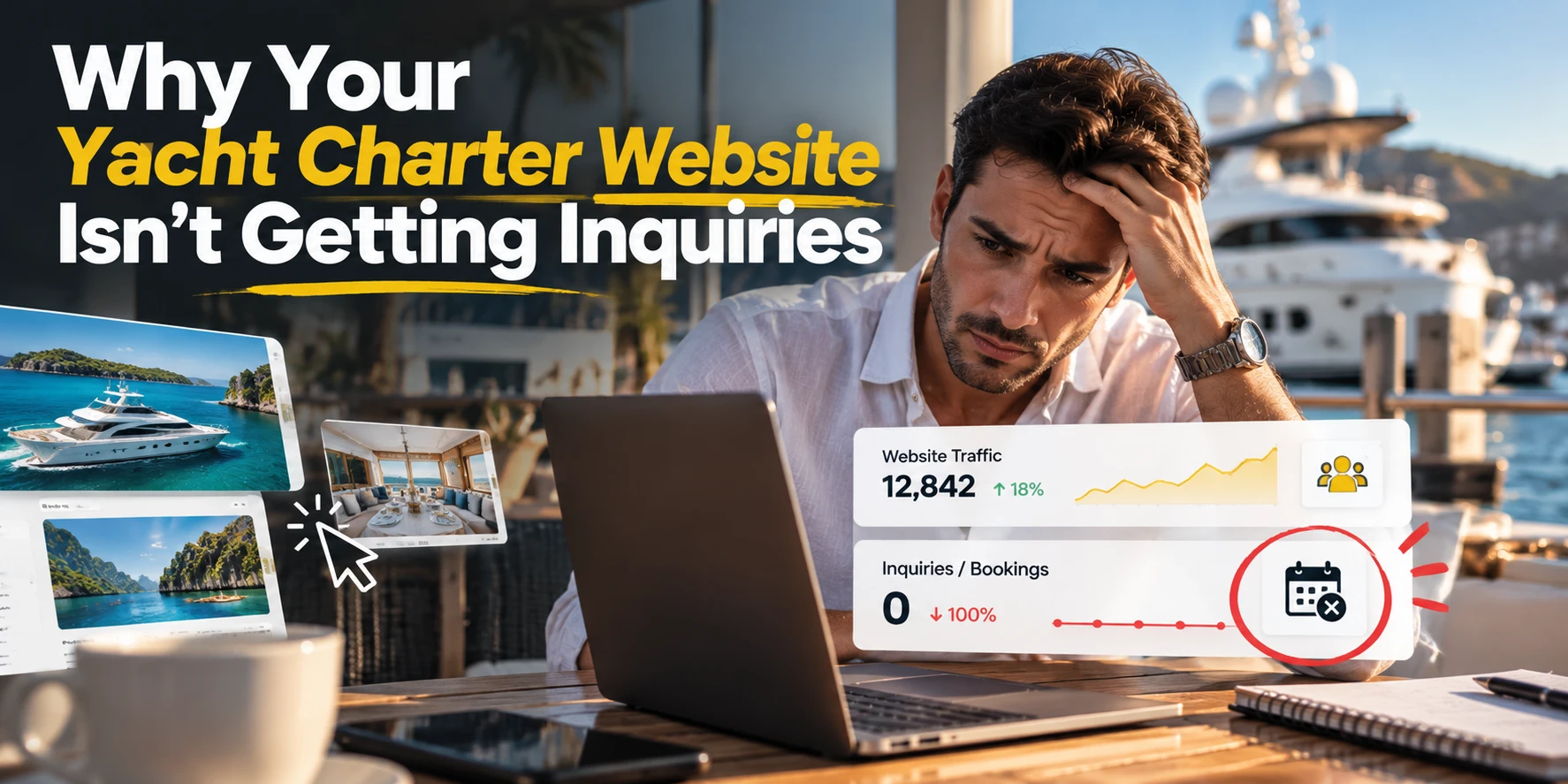
- Low inquiries usually come from one of four places: traffic quality, missing website information, inquiry friction, or weak lead handling and tracking.
- Before they contact you, guests need three answers: roughly what it costs, whether it’s the right yacht and experience, and what happens after they inquire.
- The seven most common fixes: pricing guidance, complete vessel pages, a shorter inquiry form, more contact options, sample itineraries, stronger trust signals, and faster follow-up.
- Track the full funnel in GA4 and your CRM, from vessel view to confirmed charter. Clicks and form fills aren’t qualified leads.
- SEO should connect destinations, charter types, and individual vessels, so visitors with real charter intent find the right yacht and can request a quote easily.
A yacht charter website may receive traffic without generating inquiries because visitors can’t easily understand charter prices, compare vessels, evaluate destinations, trust the operator, or contact the business conveniently.
Sometimes the issue isn’t your website design at all. You may be attracting people researching luxury yachts rather than travelers actively planning a charter. The solution is to find where potential guests lose interest and improve the path from finding your site to requesting a charter.
This guide covers seven common yacht charter website problems, how to improve vessel pages, what to track in GA4, and how to generate more qualified inquiries through yacht charter SEO and better lead follow-up.
Why Is Your Yacht Charter Website Getting Traffic but No Inquiries?
Website traffic and charter inquiries measure two different stages of the customer journey. One visitor might be curious about yacht prices, researching a destination, or planning an event months away. Another may already know their dates, group size, and budget, but leave because your site doesn’t give them enough to request a quote with confidence.
For most charter operators, low inquiries fall into four categories:
- Traffic qualityVisitors are browsing yachts or researching destinations without immediate charter intent.
- Website informationSpecifications, pricing, availability, and itineraries don’t answer key buying questions.
- Inquiry frictionForms, contact options, or mobile usability make requesting a quote harder than it should be.
- Lead handling and trackingInquiries aren’t answered promptly, recorded properly, or converted into confirmed charters.
Knowing which category applies helps you avoid spending money on the wrong solution.
How to identify where yacht charter leads are being lost
| What you notice | Possible cause | What to investigate |
|---|---|---|
| High traffic, few vessel views | Informational traffic or weak navigation | Landing pages, search intent, fleet navigation |
| Many vessel views, few inquiries | Incomplete pricing or vessel information | Specifications, inclusions, trust signals |
| Many form starts, few submissions | Complicated or broken inquiry form | Required fields, form errors, mobile usability |
| Many WhatsApp clicks, few conversations | Contact friction or irrelevant traffic | Message handling and qualified conversations |
| Many inquiries, few accepted quotes | Budget mismatch, availability, or sales process | Response times, lead quality, quote accuracy |
| Many quotes, few confirmed charters | Pricing, conditions, competition, or trust | Quote follow-up, objections, deposit process |
Use this table to guide your investigation. High vessel page views don’t automatically mean strong booking intent, and not every visitor is ready to request a charter.
What Makes Someone Inquire About a Yacht Charter?
A yacht charter usually takes more consideration than an ordinary activity booking. Guests may be weighing a significant spend, coordinating several people, comparing vessels, and planning around dates or destinations. Before contacting you, they typically need three questions answered:
- What will the charter roughly cost? Not a final quote, but enough pricing information to know whether a vessel fits their budget.
- Is this the right yacht and experience? Guest capacity, amenities, crew, destinations, itinerary options, and whether it suits their occasion.
- What happens after I inquire? Whether they’re requesting information, getting an estimate, holding a date, or committing to a booking, and when they’ll hear back.
A website that answers these questions reduces uncertainty and leads to better-informed inquiries.
7 Reasons Your Yacht Charter Website Isn’t Generating Inquiries
1Your Yacht Charter Pages Don’t Show Any Pricing Guidance
“Contact us for pricing” leaves visitors unsure whether a yacht costs $1,000 or $10,000.
Some travelers will request a quote anyway. Others leave because they don’t want to start a sales conversation without knowing whether the charter fits their budget. Pricing can be complex: a private day charter might be a standard vessel-and-crew package, while a multi-day luxury charter can involve seasonal rates, fuel, provisioning, taxes, and gratuities. The goal is useful guidance without misrepresenting the final price.
Where practical, show starting prices or indicative ranges. A vessel page might explain:
- Half-day, full-day, and weekly rates (if offered)
- What the quoted base rate includes
- Additional expenses that may apply
- How season, guest count, or itinerary affects price
For professionally crewed yachts, explain arrangements such as any Advance Provisioning Allowance (APA), taxes, or gratuities. Don’t bury mandatory charges in vague wording that makes the price look lower than it is. If the final quote depends on availability and itinerary, say so clearly.
2Your Vessel Pages Don’t Answer Important Charter Questions
Beautiful photos, very little practical information. A gallery alone can’t tell serious prospects what they need to compare vessels.
A corporate group needs to know capacity and deck space. A family planning an overnight charter cares about cabins, bathrooms, crew, and sleeping arrangements.
Create a complete page for each yacht you actually offer, including:
- Vessel name, type, and length
- Location and departure marina
- Maximum day guest capacity, and overnight capacity where applicable
- Number and configuration of cabins
- Crew arrangements and onboard amenities
- Water toys and recreational equipment
- Included services and optional extras
- Pricing guidance and relevant itinerary options
- Availability or inquiry process
Use genuine photos of the actual vessel: exterior, main deck, cabins, bathrooms, dining and entertainment areas. Add a short video walkthrough if you have one.
Why this matters for SEO
Each vessel page should have a distinct purpose and accurately represent that specific yacht, explaining how the vessel, its location, its capabilities, and the experiences it supports relate. A yacht available for private day charters in Miami should cover its capacity, typical departure point, available experiences, and services. Avoid dozens of near-identical pages that just swap yacht names or city keywords.
3Your Yacht Charter Inquiry Form Is Too Complicated
The form asks for exact dates, full passenger details, meal preferences, budget, and pickup arrangements before the first conversation.
An interested visitor may have an approximate date but no confirmed guest list, or want to understand total cost before choosing an itinerary. Those details matter eventually, just not all at once.
Keep the first step focused on starting a useful discussion:
- Name
- Email or preferred contact method
- Approximate charter date
- Estimated guest count
- Selected yacht or charter type
- Optional message
For more complex charters, add an optional budget range or preferred itinerary if it improves quoting. Don’t ask for sensitive passenger information before it’s operationally necessary. Your team can clarify the rest after the inquiry.
Make the form mobile-friendly
Make sure it works on phones, shows clear validation messages, confirms submission, and keeps entered details when someone corrects a field.
4Your Website Doesn’t Offer Convenient Contact Options
Only one way to get in touch, even though guests differ in how they want to communicate.
Some prefer email and a written quote while they compare vessels. Others want a quick WhatsApp chat about dates. International travelers often find messaging easier than a phone call.
Offer the channels your team actually handles: an online inquiry form, WhatsApp, email, a click-to-call number, or a charter planning appointment. Make them easy to find on vessel pages and on mobile. For WhatsApp, use a prefilled message with the vessel name and context:
Only use channels you can reliably monitor. If no one answers WhatsApp outside business hours, don’t promise instant replies.
5Your Website Doesn’t Show What the Charter Experience Looks Like
Visitors like the yacht but can’t picture the day: where it departs, where it goes, what guests can do, and how long it takes.
Publish sample itineraries for your real routes and experiences, such as:
- Half-day coastal charter
- Full-day island-hopping charter
- Sunset cruise
- Corporate yacht event
- Birthday or celebration charter
- Multi-day luxury itinerary
Cover approximate duration, departure point, possible stops, onboard activities, and suitability for different groups. Describe routes as illustrative when they depend on weather, sea conditions, local regulations, or captain approval, and don’t promise access to restricted destinations or activities.
How itinerary pages support yacht charter SEO
Destination and itinerary pages can target searches beyond your vessel names, like private yacht experiences in Biscayne Bay for a Miami operator, or specific islands and cruising areas for a Mediterranean one. The key relationship is:
Internal links should let someone reading a destination itinerary find the yachts that actually serve that route.
6Your Yacht Charter Website Doesn’t Establish Enough Trust
Old reviews, generic images, unclear business details, or thin safety information raise doubts about a significant purchase.
Guests need confidence that the yacht, operator, crew, and reservation arrangements are legitimate, especially international travelers who can’t inspect the yacht before booking.
- Genuine, recent customer reviews
- Accurate vessel photographs
- Operator identity and contact information
- Crew credentials where appropriate
- Applicable licenses, certifications, and insurance information
- Clear cancellation and weather policies
- Payment and deposit conditions
- How reservation and confirmation work
Put relevant reviews on vessel pages instead of a separate testimonials page. Get permission before using guests’ photos or testimonials, and avoid invented scarcity, exaggerated luxury claims, or unsupported safety and service statements.
7Your Team Responds Too Slowly to Charter Inquiries
The website generates qualified inquiries, but the sales process stalls after submission while the guest compares other operators.
Define how inquiries are received, assigned, and answered. An effective workflow:
- A visitor submits a vessel inquiry.
- The system records it in a CRM.
- An automatic confirmation acknowledges receipt.
- The inquiry is assigned to the right team member.
- Staff check availability and prepare a relevant response.
- The prospect gets an answer, or a clear timeframe for their quote.
- Appropriate follow-up happens if they haven’t replied.
Out-of-hours auto-confirmations set expectations, but automation should never promise availability, guarantee pricing, or confirm a booking without verification.
How to improve follow-up quality
Your first personal reply should address the actual request. If they asked about a sunset charter for ten guests, don’t send a generic fleet brochure. Send the relevant vessel options, indicative pricing, and the next step to prepare or confirm a quote. Where appropriate, follow up with alternative dates or vessels.
What Should a High-Converting Yacht Charter Vessel Page Include?
A vessel page should answer what a prospective guest needs to know before requesting a charter, balancing practical information with strong visuals.
| Page section | Information to include |
|---|---|
| Hero section | Actual yacht photo, name, type, location, and primary inquiry CTA |
| Pricing | Starting rate or indicative pricing, with exclusions explained |
| Key specifications | Length, day capacity, overnight capacity, cabins, and crew |
| Yacht gallery | Exterior, decks, cabins, bathrooms, and relevant amenities |
| Experiences | Suitable itineraries and charter occasions |
| Inclusions | Crew, equipment, refreshments, fuel arrangements, and extras |
| Trust information | Reviews, operator details, and applicable credentials |
| Inquiry options | Short form and supported contact methods |
| FAQs | Weather, cancellation, deposits, itinerary changes, and booking terms |
How to Track Yacht Charter Inquiries in Google Analytics 4
If you don’t know how many visitors submit inquiries, you may have a measurement problem. GA4 can show which pages and channels contribute to leads, but button clicks and form submissions aren’t the same as qualified charter opportunities.
Recommended website events
| Visitor action | Suggested GA4 event | Purpose |
|---|---|---|
| Vessel page viewed | view_vessel | Interest in individual yachts |
| Inquiry form started | form_start | Form engagement |
| Inquiry form submitted | generate_lead | Record a new inquiry |
| WhatsApp button clicked | contact_whatsapp_click | Messaging intent |
| Phone number clicked | contact_phone_click | Call intent |
| Quote requested | request_quote | Quote-stage actions |
| Charter confirmed | CRM or booking-system outcome | Actual sales |
generate_lead is a GA4-recommended event. The vessel, WhatsApp, phone, and quote events are suggested custom events. Don’t treat page views or button clicks as confirmed leads.
Build an inquiry funnel
The first stages can be tracked on your website. Later stages need reliable CRM or booking-system records. Together they show whether your real problem is website conversion, qualification, quoting, or closing.
Calculate inquiry conversion rate and cost per qualified inquiry
Neither number tells you on its own whether performance is good. Consider traffic intent, charter price, seasonality, availability, lead quality, and how many inquiries become confirmed charters. If only one of those 15 inquiries books, look at the wider acquisition process before judging the campaign, and always compare acquisition costs with charter revenue and contribution margin.
How Yacht Charter SEO Can Generate More Qualified Inquiries
Not every charter business needs more visitors. Some need more relevant ones. A site can attract thousands of people researching yacht prices or browsing luxury photos without producing real charter demand. A stronger SEO strategy connects search intent with your actual services.
Target specific yacht charter searches
- Private yacht charter in [destination]
- Luxury yacht rental in [destination]
- Sunset yacht charter in [destination]
- Corporate yacht charter in [destination]
- Crewed yacht charter in [destination]
- Week-long yacht charter in [cruising area]
These are example search topics, not verified keyword-volume recommendations. Choose targets based on your services, vessels, search demand, and competition.
Organize your website around destinations, services, and vessels
- Destination pagesWhere your yachts operate, departure locations, cruising areas, and available experiences.
- Charter service pagesDistinct offerings such as day charters, luxury vacations, corporate events, and private celebrations.
- Individual vessel pagesSpecifications, pricing guidance, availability, photos, and everything needed to evaluate a specific yacht.
Supporting itinerary guides connect these naturally. The structure should reflect real relationships between offerings, not duplicate pages for every keyword combination.
Why technical SEO matters
Even useful vessel pages can struggle when technical issues limit visibility. Check for:
- Important vessel pages excluded from indexing
- Weak internal navigation
- Duplicate or outdated vessel listings
- Broken links from destination pages
- Slow mobile pages
- Incorrect canonical tags
- Poorly implemented JavaScript galleries or inquiry forms
My SEO strategy, technical SEO, and local SEO services address how search visibility, site structure, and commercial performance fit together. For charter operators, the goal is to attract people looking for relevant yachts and experiences, then make requesting a quote straightforward.
What about Google Business Profile?
Eligible charter businesses can benefit from Google Search and Maps visibility. But a marina berth or temporary boarding location doesn’t automatically qualify as a separate business location. Follow Google’s eligibility rules, use accurate details, categories, and locations, and don’t create profiles for every yacht or departure point unless each independently qualifies.
A Related Tourism SEO Example: France Luxury Tour
Yacht charter marketing has its own buying process, but its search architecture shares principles with other luxury tourism businesses. My France Luxury Tour case study covers SEO strategy and site architecture for a luxury tour business.
The shared principle is organizing a site around destinations, individual experiences, and the information travelers need to evaluate them. For a charter business, that means clear relationships between cruising destinations, charter types, vessels, and inquiry opportunities. For a luxury tour business, it connects destinations, tours, and itineraries. These relationships help visitors reach relevant services and give search engines clearer context.
A Practical 30-Day Yacht Charter Inquiry Improvement Plan
You don’t need a full redesign to start. Begin with the pages and inquiry processes that matter most.
Audit traffic and inquiry tracking
- Review your most visited vessel and charter service pages.
- Check where traffic comes from and whether visitors match your offerings.
- Test forms, contact buttons, and the mobile inquiry process.
- Confirm successful inquiries are recorded accurately.
Improve your most important vessel pages
- Prioritize vessels with real visitor interest and commercial value.
- Add missing specifications, pricing guidance, inclusions, authentic images, and clear inquiry options.
- Make the information easy to find on mobile.
Improve lead handling
- Review how inquiries are received and assigned.
- Add automated confirmations and set realistic response-time expectations.
- Track qualified inquiries and quote progress in a CRM or equivalent.
Review SEO and conversion opportunities
- Strengthen internal links between destination, service, itinerary, and vessel pages.
- Review indexing and technical SEO issues on important pages.
- Compare inquiry performance with your baseline and pick the next improvements.
These steps create a basis for measurement. They don’t guarantee a specific increase in inquiries within 30 days.
Yacht Charter Website Inquiry Checklist
Before spending more on advertising or a redesign, review these essentials:
- The website attracts searches relevant to available charter services.
- Individual vessel pages provide accurate specifications.
- Guests can understand approximate pricing and key exclusions.
- Suitable itinerary examples are available.
- Real vessel photographs show important onboard areas.
- Inquiry forms are short and work on mobile.
- Contact options are visible and monitored.
- Reviews and operator information establish credibility.
- Inquiry submissions are tracked correctly.
- Sales staff have a consistent response and quotation process.
- The CRM distinguishes inquiries, quotes, and confirmed charters.
- Important destination and vessel pages are accessible to search engines.
When Should You Get a Yacht Charter Website and Lead Generation Audit?
If your charter website gets traffic but few qualified inquiries, more ad spend may not be the right first move. You need to know whether the issue is visitor intent, search visibility, vessel information, usability, contact methods, or how your team manages leads. A proper audit examines these connected systems, not just the visual design.
Through my SEO strategy and technical optimization services, I help businesses strengthen search visibility, improve site structure, and convert relevant traffic into inquiries. I also work on website forms, analytics, and lead-generation workflows that connect marketing activity with business outcomes.
Getting visitors but not enough qualified charter inquiries?
Book a free consultation to discuss your website, search visibility, inquiry process, and the improvements most likely to make a difference.
Frequently Asked Questions
Why is my yacht charter website getting traffic but no inquiries?
Common reasons include irrelevant website traffic, unclear charter pricing, incomplete vessel information, complicated inquiry forms, limited contact options, weak trust signals, and slow lead follow-up. Review your website and sales process together to identify the actual problem.
Should yacht charter websites display prices?
In many cases, indicative pricing helps visitors decide whether a charter fits their budget. Final rates may depend on the vessel, season, duration, itinerary, taxes, and additional expenses, so explain the pricing conditions accurately.
What should a yacht charter inquiry form ask?
A simple first form can ask for name, contact details, approximate dates, group size, preferred vessel or charter type, and an optional message. More detail can be collected during quoting when necessary.
How fast should yacht charter companies respond to inquiries?
As promptly as your operations reasonably allow. Automated acknowledgments can confirm receipt immediately, but a useful personal reply should follow within a clearly communicated timeframe. Measure response time and its relationship with quote acceptance.
Is WhatsApp better than a contact form for yacht charter inquiries?
Neither is universally better. Forms collect structured information, while WhatsApp helps guests ask quick questions. Offering both can improve accessibility when your team can reliably manage the conversations.
How can SEO help yacht charter companies get more inquiries?
Yacht charter SEO helps destination, charter service, and vessel pages become discoverable for relevant searches. It also includes site architecture, technical optimization, internal linking, and content that answers travelers’ questions before they inquire.
What is a good yacht charter website inquiry conversion rate?
There’s no universal benchmark. Conversion rates vary with charter value, search intent, seasonality, destination, and business model. Measure your own performance over time and compare qualified inquiries rather than all contact actions.
How do I track yacht charter inquiries in GA4?
Use GA4 events for form submissions, contact interactions, and quote requests. Validate that submissions succeed, and separate website interactions from qualified leads recorded in your CRM. Connect later sales stages only where supported and appropriate.
Should yacht charter companies invest in SEO or paid advertising?
Both can help. Paid ads reach relevant audiences while campaigns run, while SEO builds discoverability in organic search. The right mix depends on demand, competition, acquisition costs, and how well the website turns visitors into qualified inquiries.